

🎙️ This video is dubbed in English from the original Spanish version · Watch the original here
About Acerko Telecom
Acerko Telecom is a local internet service provider based in Lloret de Mar on Spain’s Costa Brava. Since 2015, the company has offered wireless and fiber optic (FTTH) internet over both its own network and leased infrastructure, along with voice services and IT systems support.
Costa Brava presents a particular challenge: a diverse customer base that speaks five or six different languages. Tourists, European residents, and locals all expect fast support in their language.
Facundo Minero, founder and director of Acerko Telecom, has been working with Splynx since the product’s earliest days. Rather than looking for a closed system that did exactly what he needed, he chose an open platform he could build on top of.
The challenge
With a team of 11, Acerko needed to squeeze the most out of every resource. The biggest time sink was customer support: answering calls, replying to WhatsApp messages, and managing technical incidents consumed hours the team could spend on more productive work.
Customers demanded 24-hour WhatsApp support. Keeping a person responding outside business hours was financially unviable. And when a mass outage hit, 50, 100, or 150 customers would message at the same time, creating an avalanche of duplicate tickets that overwhelmed the workflow.
Before Splynx, everything was manual: Excel spreadsheets, SEPA files sent to the bank by hand, and service blocks managed one by one. The tools had evolved over the years, but the customer support burden kept growing.
The solution
Splynx as the ISP operating system
Acerko uses Splynx to manage the entire customer lifecycle: from entering as a CRM lead, converting to a customer, signing the contract, and issuing the first invoice, through to automated SEPA bank remittances at month-end.
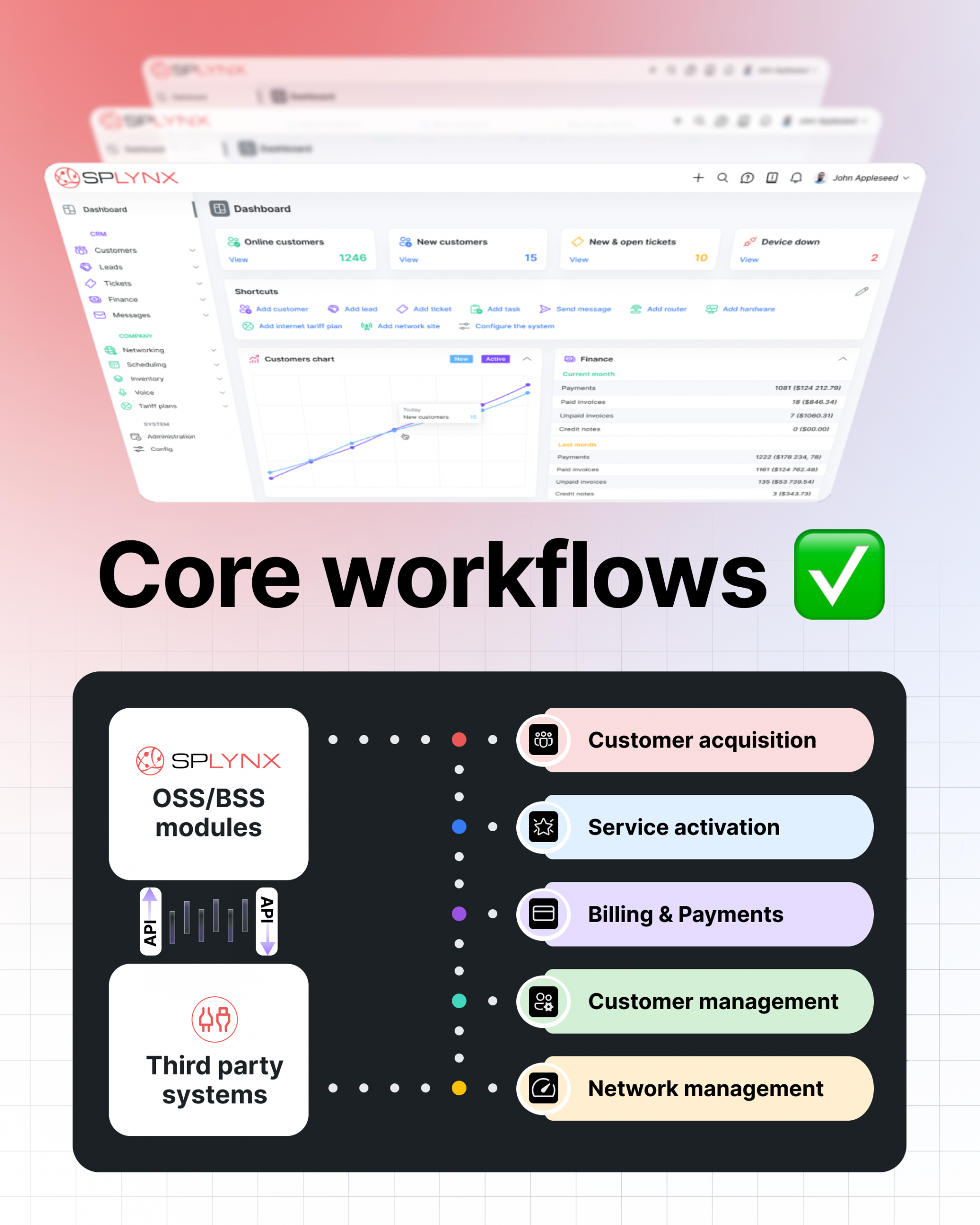
The network runs MikroTik as the core and Huawei for fiber. Splynx provisions ONTs through the Huawei add-on, configures PPPoE sessions, manages IP pools (public and private) via RADIUS, and automatically blocks customers who don’t pay.
All of this works without writing a single line of code. But what sets Splynx apart from a closed system is that it doesn’t stop there. The API, add-ons, and now the MCP servers let each ISP extend the platform to cover whatever their business needs, without starting from scratch.
After more than 10 years on the same platform, the obvious question is whether they stick with Splynx out of habit
or conviction.
What Acerko built on that foundation: Elsa Chat
To solve their customer support problem, Acerko didn’t switch platforms or buy an external solution. They built their own on top of Splynx. Five years ago they started developing Elsa, an AI assistant connected to WhatsApp via Twilio. Elsa lives inside Splynx as another admin user, with access to all customer data.
Elsa has 15-16 active functions. Among them are:
Elsa operates in multiple languages, a non-negotiable requirement on the Costa Brava where customers speak Spanish, Catalan, English, French, and German.
Elsa is just one example of what can be built. Other ISPs on Splynx have created GIS platform integrations, custom financial reports, LTE provider connections, and onboarding flows adapted to their country’s legislation. The platform is the same. What each ISP builds on top is different.
Smart handling of mass outages
When a mass outage occurs, the team notifies Elsa. From that point, Elsa stops creating individual tickets for that zone and instead informs customers about the incident. When the outage is resolved, Elsa can automatically notify all affected customers.
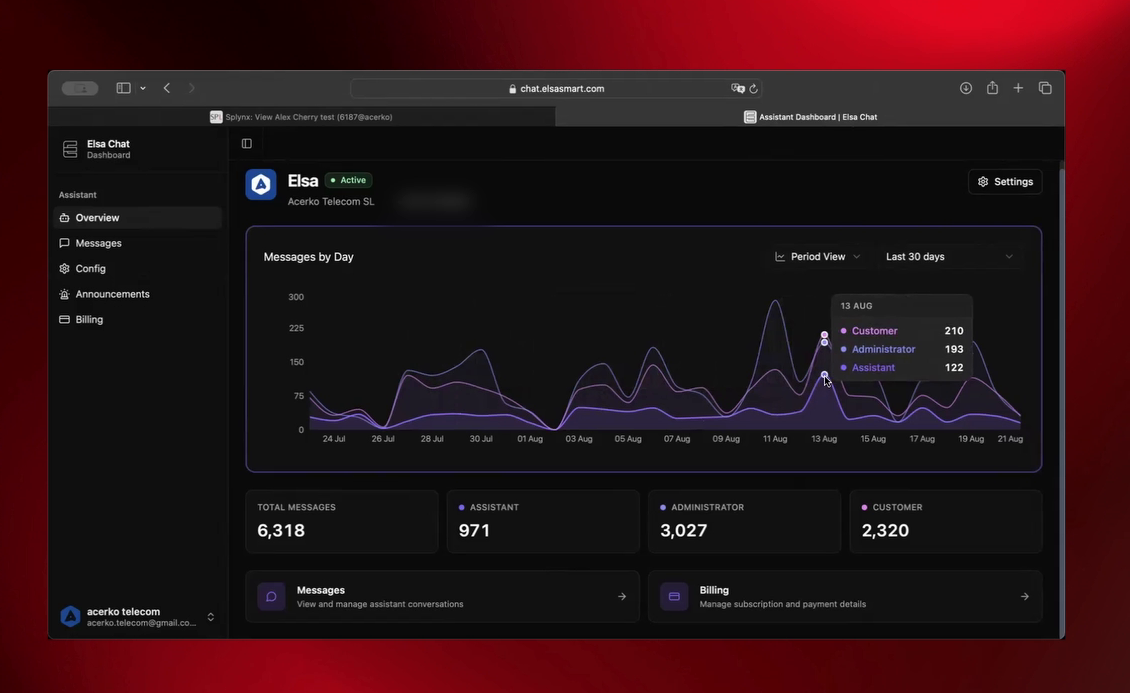
Before this feature, a single outage could generate 100 to 150 duplicate tickets, turning a helpful tool into a source of noise.
Marketing with full traceability
Acerko uses Splynx’s lead API to connect marketing campaigns (email, Google Ads) to the CRM. Every lead that enters carries a label identifying the source campaign, making it possible to calculate exactly how much money converts from campaign to customer.
The results
- 50% reduction in customer support workload
- 90% of queries resolved automatically by Elsa (technical incidents, payment management, and general inquiries)
- 24/7 support in multiple languages at no additional staffing cost
- Zero duplicate tickets during mass outages thanks to the announcement feature
- Full traceability of marketing campaign ROI, from campaign to customer
- 10+ ISPs in Spain, South Africa, and New Zealand now use Elsa, proof that what’s built on Splynx works beyond a single company
- Zero dependence on external development for key customizations: everything was built by Acerko’s own team using Splynx’s API and add-on system
Real results from ISP using Elsa
At one Spanish ISP, daily tickets grew from around 50 to over 200 – all resolved without growing the support team.
From ~50 to 200+ tickets a day
At a Spanish ISP, resolved daily without growing the team.
During one mass outage · Argentina
918
customers wrote in a single day
4,641
messages received
5.78x
the usual volume
47.4%
of replies handled by Elsa
During a single mass outage in Argentina, 918 customers wrote in one day, sending 4,641 messages – 5.78x the usual volume. Elsa handled 47.4% of those replies on its own.
This isn’t about replacing people. It’s about giving the team more capacity to solve problems, look after customers, and focus on the work that actually adds value to the ISP.
Splynx 6.0 and MCP: what took Acerko years now takes days
Acerko built Elsa by working directly with the Splynx API over five years. They had developers, patience, and deep knowledge of the system.
With Splynx 6.0, that barrier has dropped dramatically. The MCP server (Model Context Protocol) lets AI tools like Claude or ChatGPT connect directly to Splynx, read customer, billing, ticket, and network data, and take actions. A second MCP server understands Splynx’s internal architecture: it knows how code should be written, what functions are available, and where to find the data.
This means an ISP with one developer, or even without one, using AI as a coding assistant, can create add-ons, integrations, and automations that previously took months. No need to start from scratch. The skeleton with over 10 years of experience and development is already there.
The takeaway
Splynx isn’t just billing software or a network management tool. For Acerko, it’s the operating system their entire ISP runs on: billing, provisioning, RADIUS, CRM, ticketing, marketing. And when they needed something that didn’t exist, they built it on top without switching platforms.
That’s what using an open framework means instead of a closed system. The foundation handles 90% of operations from day one. The other 10% is built by each ISP to fit their own needs.
Acerko spent five years building Elsa because they started when the tools were different. With Splynx 6.0, MCP, and AI, the next ISP with a problem to solve won’t need five years. Five weeks will probably do.